

- May 22, 2026
- Watch Gonzo
- 0
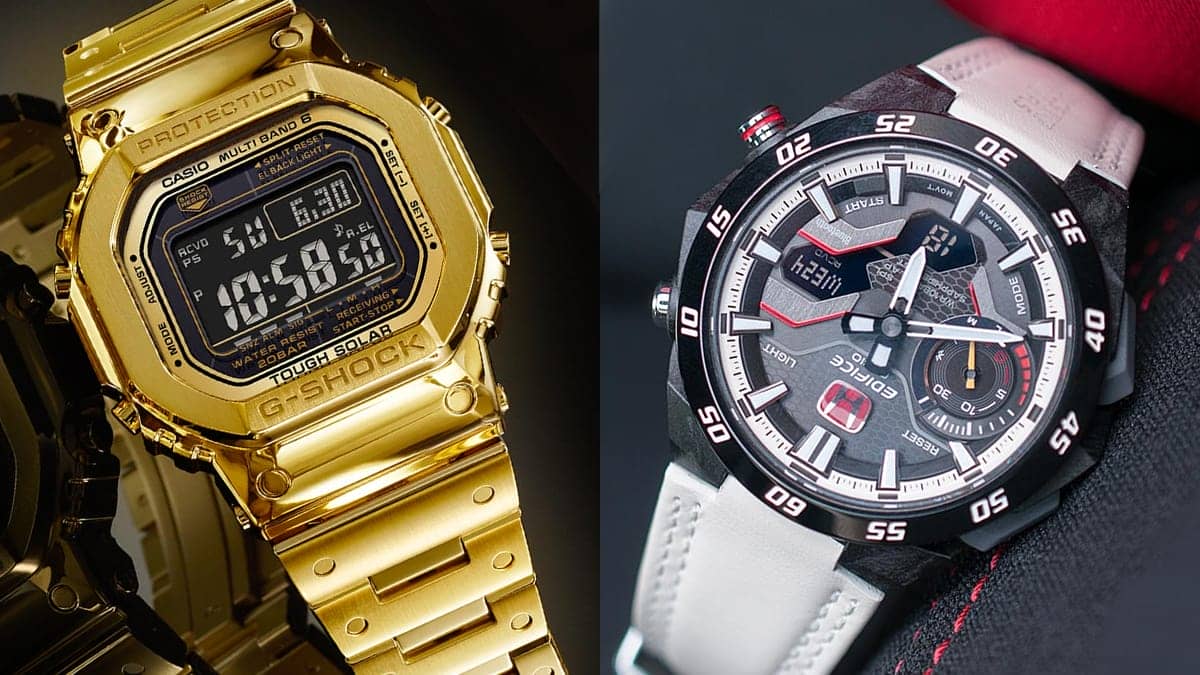
Casio makes two of the most recognisable watch lines in the world — and they could not be more different from each other. The Casio G-Shock has been synonymous with indestructibility since 1983. The Casio Edifice has been synonymous with motorsport-inspired sophistication since 2000. Both sit in the affordable-to-mid-range bracket. Both carry Casio’s reputation for reliability. But they serve completely different people, and choosing the wrong one is easy if you don’t know what separates them.
This Casio G-Shock vs Casio Edifice breakdown — essentially a Casio G-Shock watches comparison and Casio Edifice review in one — covers design, durability, features, and value. Whether you’re looking for the best Casio watches for men or just trying to decide between the two, here is everything you need
The Origins: Two Very Different Philosophies

The G-Shock was born from a singular obsession. In 1981, Casio engineer Kikuo Ibe dropped a watch given to him by his father and watched it shatter. He vowed to create something unbreakable, and the result was the G-Shock DW-5000C, launched in April 1983. The brief was the “Triple 10” concept: survive a 10-metre drop, withstand 10-bar (100m) of water pressure, and run on a 10-year battery. Ibe’s breakthrough was the “floating module” — a concept inspired by watching a ball bounce in a park — where the watch’s movement is suspended inside the case with minimal contact points, absorbing impacts before they reach the mechanism. Every G-Shock built since operates on that same principle. G-Shock stands for Gravitational Shock, and the name has been earned.
The Edifice came almost two decades later, in 2000, with the launch of the EF-100. Where G-Shock was built for people who break things, Edifice was built for people who want precision and polish. Its design philosophy, which Casio officially describes as “Speed & Intelligence,” draws directly from motorsport — tachymeters, lap-timing functions, and dials inspired by racing instrument panels. Edifice has since partnered with Honda Racing and Nissan’s NISMO division, and it was the official sponsor of the Scuderia AlphaTauri Formula 1 team. It occupies the space between Casio’s utility watches and genuine dress chronographs — a smart, professional tool watch at an accessible price.
Design and Build: Tough vs Sophisticated

The difference in feel between these two lines is immediate the moment you pick one up.
The Casio G-Shock is built for punishment. Cases are constructed from resin and rubber — materials chosen specifically for their shock-absorbing properties rather than their appearance. The bezel is large, the crown is protected, the buttons are guarded, and the overall aesthetic communicates toughness before it communicates anything else. These are Casio G-Shock tough watches in the truest sense — oversized, unapologetic, and designed to take a hit. That said, the G-Shock range now spans more than just utility beaters. The CasiOak GA-2100 proved that G-Shock can deliver a genuinely slim, fashion-friendly silhouette without compromising its core spec, and the full-metal MR-G series sits at a luxury price point with corresponding refinement.
The Casio Edifice takes an entirely different approach. Cases are predominantly 316L stainless steel, bracelets are polished and integrated, and dials are layered with racing-inspired sub-dials and tachymeter markings. The Casio Edifice analog-digital watches — the ana-digi models — carry digital functionality within an analog-dominant dial in a way that reads as modern and professional rather than sporty. This is a watch that works as well in a boardroom as it does courtside. The Casio Edifice men’s collection is designed for exactly that kind of crossover: professional enough for the office, interesting enough for the weekend.
Durability: No Contest in the Extremes

For outdoor use, active sports, and environments where a watch might genuinely be at risk, the Casio G-Shock for outdoor activities case is open and shut. Standard G-Shock models carry 200m water resistance and shock resistance built around the floating module structure — proven across four decades of hard use by soldiers, divers, construction workers, and athletes worldwide. The watch is built around the assumption that it will be dropped, soaked, frozen, and hit — and it is designed to survive all of it.
Casio G-Shock water resistance at 200m across most models far exceeds what the Edifice offers. Edifice models typically carry 100m water resistance — perfectly adequate for everyday use, swimming, and the occasional dive — but they are not rated or constructed for extreme conditions. The Edifice is resistant to the demands of professional and social life. It is not resistant to the demands of a construction site or a deep-water dive. That is not a criticism — it was never designed to be.
Casio G-Shock durable watches are in a class of their own at this price point. If your lifestyle involves outdoor activities, physical work, sport, or any environment where a watch is genuinely at risk, only one answer makes sense.
Features: Two Different Kinds of Functionality

Casio G-Shock features are built around active use: multiple alarms, countdown timers, a chronograph, world time, and a shock-resistant structure as the baseline across all models. The range then scales dramatically — entry models give you a precise, indestructible digital watch; higher-end G-Shocks add Tough Solar charging, Multi-Band 6 atomic radio timekeeping, Bluetooth smartphone connectivity, GPS, altimeter, barometer, compass, heart rate sensors, and tide graphs. The best Casio G-Shock models for sports sit in the middle of that spectrum — watches like the Rangeman (GW-9400) with its triple sensor for altitude, bearing, and temperature, or the GBD-H2000 with GPS and heart rate monitoring. These are Casio G-Shock for sports in their most capable form.
Casio Edifice watch features are built around professional and travel use: chronographs with millisecond accuracy, tachymeters for speed calculation, world time across multiple cities, and increasingly advanced connectivity. Higher-end Edifice models carry Bluetooth Smartphone Link — which syncs the watch with a smartphone app to automatically update time zones and transfer stopwatch data — alongside Tough Solar charging and Waveceptor atomic radio synchronisation. The motorsport DNA runs through the feature set: the lap memory functions, the target time indicators, and the chronograph precision are all rooted in race timing rather than wilderness navigation.
Casio Edifice sports watches are a different kind of sports watch — precision instruments for trackside, boardroom, and business travel, not mountain trails or ocean floors.
Price and Value

Both lines span a wide range, but the overlap is meaningful. Entry G-Shocks like the DW-5600 start under $100. Entry Edifice chronographs sit in a similar bracket. Mid-range G-Shocks with Tough Solar and Multi-Band 6 run $150–$400. Mid-range Edifice models with Bluetooth and solar sit in a similar window. Premium G-Shocks (the full-metal line, GPS models) can exceed $500 — the MR-G series goes considerably higher. The Edifice tops out around $300–$500 for most mainstream models.
For the money, both represent exceptional value against Swiss or German equivalents. Any honest Casio G-Shock review will point out that the best affordable Casio watches from either line deliver features that would cost several times more from a European manufacturer. Casio Edifice price across most mainstream models sits between $50 and $500, with the majority of popular references well under $300. The Casio G-Shock features list — shock resistance, 200m WR, solar, atomic timekeeping — at $200 is simply unmatched anywhere else. The Edifice’s motorsport chronograph credentials at $150–$300 are equally difficult to rival.
Which One Is Right for You?

These are best durable Casio watches for two different definitions of durable. The G-Shock is for people who work, play, or operate in environments where a watch takes real punishment — outdoor activities, physical sports, active lifestyles, or anyone who simply wants the confidence of knowing their watch will survive whatever happens. The Edifice is for people who want a smart, professional timepiece with genuine precision and a refined look — daily office wear, business travel, and social occasions where a G-Shock would look out of place.
These are Casio watches for sports and everyday use — just different kinds of sports and different interpretations of everyday
Frequently Asked Questions
The Casio G-Shock is significantly better for outdoor activities. It carries 200m water resistance, a proven shock-resistant structure built around Ibe’s floating module design, and purpose-built features like altimeters, compasses, tide graphs, and GPS on higher-end models. The Casio Edifice is built for professional and casual environments, not extreme outdoor conditions.
Casio G-Shock launched in 1983 with an emphasis on indestructibility — resin cases, 200m water resistance, and a floating module that absorbs shocks. Casio Edifice launched in 2000 with a motorsport-inspired philosophy — stainless steel cases, polished dials, precision chronographs, and a design suited to professional and social settings. G-Shock is tougher; Edifice is more refined.
The Casio G-Shock is the clear choice for sports and fitness. Dedicated sport models like the Rangeman (GW-9400) include altitude, bearing, and temperature sensors. The GBD-H2000 adds GPS and heart rate monitoring. The Casio Edifice‘s motorsport features — lap timing and tachymeters — are built for track-side precision rather than active physical training.
Yes. The Casio Edifice is specifically designed for professionals. Its stainless steel construction, motorsport-inspired design, and advanced features like Bluetooth time sync, world time, and precision chronographs make it a credible and sophisticated option for the office, business travel, and formal settings — at a price point well below comparable dress watches from other brands.